
Status Dot — The Compositional Vocabulary
The single status dot reused on the sidebar window row, the dashboard window cards, and the pane-panel header. It tells the window’s local story — what runs in this pane: which journey, is anyone working right now, did the pipeline fail here, does it need me — using two orthogonal visual channels plus three additive overlay flags: core hue = journey, shape = liveness (the same meaning in every hue), a red center = the pipeline failed here, a constant-yellow pulsing halo = the agent is waiting on you, and — on the sidebar window row only — a neutral underbar = on the fab operator’s watchlist. The remote story — the branch’s PR on GitHub — lives on the row’s right-edge PR glyph, never on the dot. There is no matrix to memorize: hue × shape × overlays compose freely and no cell is special.
Implementation: app/frontend/src/components/status-dot.tsx (rendering) +
app/frontend/src/components/pr-status-model.ts (statusDotState / fabPhase /
PHASE_HUE / prOwnsGlyph / prGlyphColor). Design authority:
docs/specs/status-pyramid.md.
Precedence — which input drives the dot (two families joined at the top)
The dot’s core hue is owned by two ladders joined at the top — the first precondition that
holds wins. Shape is liveness, derived per family: the journey hues (blue · green · yellow)
read the window’s rolled-up agentState ONLY (absent or stale ⇒ ring — a dev server flowing
output in a fab worktree must NOT render solid; the output-flowing fallback is the gray floor’s
alone). failed and waiting are additive overlays, computed independently (ladder-exempt,
never tiers of their own). No PR branch exists anywhere in the ladder — the dot never
consults PR fields:
fabChange ?  (stage ∈ {intake, apply, review} ? blue-building : green-PR-ready)  [cool = fab pipeline]
          :  (fresh agentState ? yellow agent : gray floor)                      [warm = ad-hoc agent / floor]
shape     →  journey hues: solid iff agentState === "active", else ring · floor: output flowing ? solid : ring
failed    →  additive red center, over either shape (fabDisplayState === "failed" — fab hues only)
waiting   →  additive constant-yellow halo, over anything (core hue + shape kept)
The glance rule: blue = still cooking, green = out the door / done, yellow core = my ad-hoc agents, gray = just a terminal, yellow glow = needs me now, red center = my pipeline failed here.
- Cool family — fab pipeline (the pane’s worktree has an active fab change):
stage ∈ {intake, apply, review}→ blue building (pre-PR work).- every other stage (
ship,review-pr,done, unknown) → green PR-ready — the change has completed its local work (“the PR is ready”). The blue↔green split is stage-based, neverprNumber-based; its alignment with PR existence is emergent (/git-prcreates the PR mid-ship), not a stage check. - shape comes from the window’s rolled-up
agentState, not from stage bookkeeping: a stage markedactivewhose agent has been idle for hours renders a ring, not a solid — solid is physically honest (agentStateis PID-reconciled server-side, so it cannot outlive the process). - a
skippeddisplay-state makes the window not fab-owned — the change has left its journey, so the ladder simply falls through (agent tier, then floor).
- Warm family — ad-hoc agent (no fab change, but a fresh
@rk_pane_agent_state) → yellow (solid mid-turn, ring when the agent is idle or waiting — blocked is at rest by definition). - Floor (no fab change, no fresh agent) → monochrome gray tmux activity (solid while output flows, ring when quiet) — the one place output drives the shape.
The four legend strips
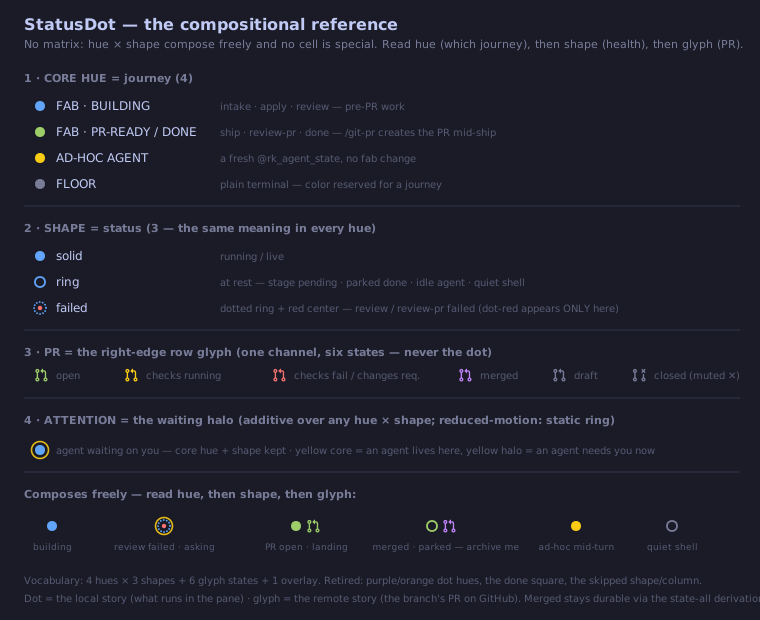
1 · Core hue = journey (4)
| Hue | Token | Hex (ref) | Means |
|---|---|---|---|
| blue | text-signal-blue | #60a5fa (dark; #2563eb light) | fab building — intake · apply · review (pre-PR work) |
| green | text-accent-green | theme green | fab PR-ready / done — ship · review-pr · done (local work complete) |
| yellow | text-signal-yellow | #facc15 (dark; #b07d02 light) | ad-hoc agent — a fresh @rk_pane_agent_state, no fab change |
| gray | text-text-secondary | gray | floor — plain terminal; color is reserved for a journey |
The purple and orange PR hues are retired from the dot — purple survives in the glyph and the
PR text surfaces. The fab hue is a two-stop progress bar, not a stage map: exactly two fab
hues, answering “still cooking vs out the door” at a glance; the exact stage lives in the fab
register on the hover card and the PANE panel.
2 · Shape = liveness (2 — the same meaning in every hue)
| Shape | Rendering | Means |
|---|---|---|
| solid | filled circle in the core hue | work happening NOW — agent mid-turn (agentState: active, PID-reconciled); floor: output flowing |
| ring | hollow circle, 1.8px border in the core hue | at rest — no live worker · idle agent · waiting agent · parked done · quiet shell |
The shape source is per-family: journey hues read the rolled-up agentState only (absent or
stale ⇒ ring); the output-flowing signal belongs to the gray floor alone. Solid cannot outlive
its process (the server-side PID reconciler clears a dead agent’s state) — but solid is not
proof of progress: a live-but-wedged agent stays solid until the reserved stuck overlay
exists.
A parked-done change is a green resting ring — resting, journey complete; the purple merged glyph (when a PR exists) says how it ended. All unflagged dots render at one uniform 7px footprint.
3 · Overlays = additive flags (3 — over any hue × shape; never a tier, never destructive)
| Overlay | Rendering | Means |
|---|---|---|
| failed red center | a small (~3px) red center dot flagged over the base shape, at a 9px footprint | review / review-pr failed here (fab fabDisplayState === "failed") — the only dot-red |
| waiting halo | a constant-yellow pulsing box-shadow ring around the dot (rk-waiting-halo) | an agent is waiting on you — blocked, therefore at rest: the halo always wraps a RING |
| watched underbar | a 1px neutral bar (text-text-secondary, painted from currentColor) 4px below the dot — 3px below the 9px flagged footprint — sidebar window row only | the window is on the fab operator’s watchlist — a relation, so never a hue and never a shape; stale (the operator loop’s tick overdue) = dimmed AND dashed (opacity-50 plus a 1px-on/2px-off dash), static |
Failure and liveness are orthogonal: over a ring, the red center sits inside the hollow
ring (“failed, nobody on it — act”); over a solid, the flag cuts a dark gap ring
between the fill and the red center — a bullseye silhouette, so failure is never encoded in
color alone (colorblind a11y). Flagged dots keep the 9px footprint (failure salience does not
drop); unflagged dots stay at 7px. Under prefers-reduced-motion the halo renders as a static
yellow ring — attention is never encoded in motion alone.
Yellow is the agent color in both roles — yellow core = “an ad-hoc agent lives here”, yellow halo = “an agent needs you now” — the glow never claims the window is ad-hoc, because family identity lives strictly in the core.
The watched underbar renders only where the row passes the watched flag — today the sidebar
window row alone; the dashboard window cards, the pane-panel header, the status bar, and the tty
tile header render no bar. It is the same neutral ink whatever the dot’s hue, so it can never
read as a journey position, and it clears the waiting halo’s reach by sitting below it. The
watchlist’s full story (stage, repo · branch, tick age) lives in the opr register on the hover
card and the PANE panel.
4 · PR = the right-edge row glyph (one channel, six states — never the dot)
A window with an owned PR (prOwnsGlyph: prNumber present with a known owned state — open, merged, or closed; unknown/unconfident states never own) shows a
git-pull-request glyph at the row’s right edge, colored by prGlyphColor — first match wins, and
the order is the design:
| Color | Token | Icon | Means |
|---|---|---|---|
| red | text-signal-red | ✕ closed icon | closed — GitHub’s closed red (matches the register’s PR_STATE_COLORS.closed); sits above fail (stale checks are noise, and passing checks must not fall through to green); the ✕ shape separates it from a failing PR |
| purple | text-signal-purple | normal | merged |
| red | text-signal-red | normal (or draft) | checks fail / changes requested — fail stays on top of every open state; a failing draft keeps the draft shape |
| gray | text-text-secondary | dotted-rail draft icon | open draft — the only gray glyph state; muted even while its checks run (draft outranks pending) |
| yellow | text-signal-yellow | normal | open, checks running (prChecks: pending) |
| green | text-accent-green | normal | open, checks pass or no decisive signal |
A closed-unmerged PR earns the red ✕ glyph (its register line is unchanged) — a dead PR is a
glance-level “this window needs a decision” signal. Shape and color divide the work: closed and
failing share red and are separated by shape (✕ vs arc); draft is the only gray state and also
carries its own shape (the dotted merge rail, GitHub’s draft silhouette), so it never reads as an
open PR in a dim theme or to a colorblind viewer. The icon is picked once, by prGlyphIcon
(✕ closed first, dotted-rail draft, arc otherwise), at every glyph site. The glyph is
deliberately not family-gated: any pane whose branch has an owned PR shows it — even a plain
floor pane whose dot stays gray (derivation is universal, Constitution Principle X).
Reading a row — composed examples
Read hue, then shape, then overlays, then glyph:
| Dot | Glyph | Reads as |
|---|---|---|
| blue solid | — | worker building — a fab change with a live agent mid-turn |
| blue ring + red center | — | review failed, nobody on it — act |
| blue bullseye (solid + gap ring + red center) | — | review failed, rework agent live |
| blue ring + red center, yellow halo | — | review failed and the agent is asking |
| blue ring, yellow halo | — | intake stage, agent asking |
| blue ring + underbar | — | building, at rest, watched by the operator |
| blue ring, yellow halo + underbar | — | watched agent asking |
| blue ring, dashed dim underbar | — | watched, operator loop stale (dimmed + dashed) |
| green ring | purple | merged and parked — archive me |
| gray solid | — | build running (floor — output flowing) |
| gray ring | — | quiet shell |
D2 — merged / closed-PR derivation (feeds the glyph)
The backend branch→PR derivation queries all PR states (gh pr list --state all) and picks by
precedence: an open PR (most recently updated) wins; else the most recent merged PR; else
the most recent closed PR. A merged PR therefore keeps resolving positive on every pass, so
the glyph’s purple merged state is durable statelessly — derived fresh from gh each cycle,
with no in-memory grace clock and nothing for an rk restart to wipe. A closed-unmerged PR is
still derived (it shows in the L3 register) and feeds the red ✕ glyph as well. Branch-reuse
edge: an open PR always outranks an older merged one on the same branch. (Pre-eviction this
durability fed the dot’s purple done-square; the mechanism is unchanged — only its consumer moved
to the glyph.)
Row Minimalism — glyphs on the row, detail on hover
The sidebar window row’s trailing status text cluster — the stage word (intake, red when
failed) and the duration text — is removed; the window name gets the freed width back (less
truncation, especially on mobile). The row’s status signals are glyphs only: the leading StatusDot,
plus the rest-state PR glyph above. The PR glyph is informational — it swaps out for the pin and ✕
actions the moment you hover the row.
Where each removed signal survives:
| Removed from the row | Survives as |
|---|---|
stage word (review) | the dot’s core hue at a glance (blue = pre-PR, green = PR-ready); the exact stage in the hover card and the PANE panel |
| failed-red stage text | the dot’s red-center overlay (over whichever base shape the window’s liveness gives — ring + center when nobody is on it, bullseye while a rework agent is live) |
done-parking suppression | the dot’s green resting ring |
| PR states (merged / failing / pending / draft / closed) | the right-edge PR glyph (purple / red / yellow / gray dotted-rail / red ✕) |
| idle / elapsed duration | the hover card’s agt register + the PANE panel register view |
waiting Xm | the additive halo + the agt register on both surfaces |
Hover any row for the full picture. Resting the pointer on a window row opens a card at the
sidebar’s right edge — same position every time, so it never jumps around under the pointer. It
shows the dot’s own label, the fab and pr registers (joined by the opr watchlist register
when the fab operator monitors the window; out/agt are omitted — the row itself already
carries those facts), how long ago the PR status was checked, and an
“Open PR #N” link. The card also opens when you focus a row with the keyboard (Escape dismisses
it), and on a touch device by tapping the row’s status dot.
The PANE panel is the same register view for the selected window. The four signal layers render
as separate, orthogonal lines — never collapsed — joined by the fifth opr register when the
window is on the operator’s watchlist, so the dot is a pure function of what they show
and can be mentally derived from it:
out  claude · flowing                     (L0: pane command · flowing / idle <dur>)
agt  waiting 3m                            (L1: @rk_pane_agent_state + epoch)
fab  dmex · review · failed                (L2: change id · stage · displayState)
PR   #314 open · checks fail · draft        (L3: prNumber/state/checks/review/draft)
opr  watched · review · tick 2m ago         (operator watchlist — the row's underbar)
The slug is written once — the pane’s branch carries it, so fab renders the bare change id.
The register keys are fixed-width 3-char (out/agt/fab/PR/opr), matching the panel’s existing
tmx/cwd/git vocabulary. Absent layers render as absent (a plain shell pane shows only out).
The L3 PR register shows for any pane with a prNumber (universal derivation, even a plain
pane whose dot stays gray). The row’s rest-state PR glyph is stricter — it renders only for an
owned PR; a closed PR keeps its register line and shows the red ✕ row glyph (unknown or
unconfident states still show no glyph). The session tiles
(the /$server dashboard) carry the same dot + rest-state glyph pair per window tile.
Where red appears
- On the dot: only as the small red center of the failed overlay — inside the hollow ring at rest, or as the bullseye’s center over a solid — never as a whole-dot color, and never as an attention signal (attention is the yellow halo). It is an overlay, not a shape: it composes with either liveness base.
- On the glyph: a failing PR (checks fail / changes requested) — the remote-failure signal — or a closed PR (the ✕ shape says which).
The two channels never share a fact: dot-red is your pipeline failed here, glyph-red is the PR is failing on GitHub or was closed there.
Accessibility
Every dot carries role="img" + aria-label composed from hue word + liveness word +
flags — a pure function of what the dot shows — so neither color nor motion is ever the sole
channel (colorblind a11y + the keyboard-first constitution). Examples: "building — worker live",
"PR-ready — at rest", "building — failed — rework live" (bullseye),
"building — failed — at rest — agent waiting 3m", "agent — idle"; the floor uses the bare
"active" / "idle". A watched window’s label grows one trailing clause after the waiting
suffix — — watched, or — watched (operator stale) when the operator loop’s tick is overdue
("building — at rest — watched"); the underbar itself is aria-hidden decoration. PR facts are
deliberately absent from the label (the glyph is
aria-hidden decoration; the flyout card and PANE panel carry the PR detail). The halo respects
prefers-reduced-motion (a static yellow ring), and the same waiting fact is carried by the
duration text and the register surfaces.
Scope notes
- Frontend only. The dot’s inputs flow on
WindowInfovia SSE (fabChange,fabStage,fabDisplayState,activity,agentState); the glyph reads the branch-derived PR fields. The backend D2 derivation (state-all precedence, default-branch carve-out #389) is unchanged. - The shared PR color vocabulary (
PR_STATE_COLORS,PR_CHECKS_COLORS,PR_REVIEW_COLORS) is preserved — it serves the glyph chain and the pane-panel PR register. - Accepted costs (documented, not bugs): with a native/headless dispatch topology, real
pipeline work whose agent lives outside the change’s window reads ring — the hover-card
fabregister disambiguates. The window rollup is one value (waiting > active > idle), so a two-pane window with one waiting + one active agent rolls to waiting ⇒ ring + halo.
Shape = liveness + the failed red-center overlay introduced by change
260903-18ot-statusdot-shape-liveness-overlays, superseding parts of
260810-aqo6-statusdot-compositional-vocabulary (the 3-shape vocabulary and shape-from-
fabDisplayState; aqo6’s PR eviction to the glyph and the two-family hue ladder stand), which
itself superseded palette v3 (260706-y1ar), extending the lifecycle journey (260615-0hsz) and
the unified StatusDot (260615-yg7f).